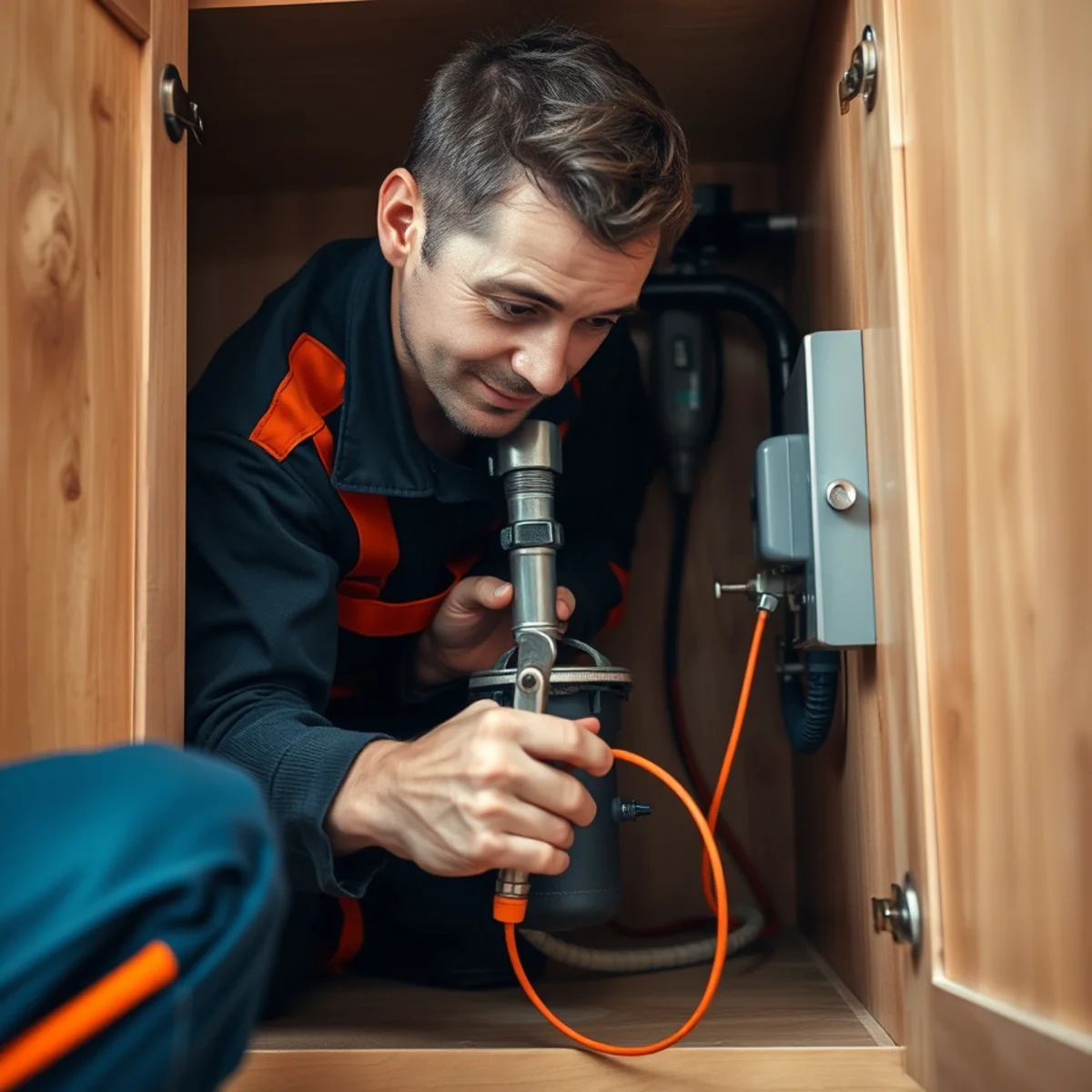
A garbage disposal that hums but will not turn is the most commonly replaced working appliance in a kitchen. It is almost always a jam, it takes five minutes to clear, and the tool you need came taped to the bottom of the unit when it was installed.
Here is how to sort it out yourself, and how to tell when it genuinely is finished.
It hums but does not turn — the classic jam
The motor has power and the flywheel is stuck. Something is wedged between the impellers and the grind ring — usually a bone fragment, a fruit pit, a piece of cutlery or a bottle cap.
- Switch it off, and cut the power. Unplug it under the sink, or switch off the breaker. Never reach into a disposal that is connected.
- Find the hex wrench. A small allen key, usually taped to the side or bottom of the unit, or in the drawer where it was put ten years ago. A quarter-inch allen key from any set works.
- Insert it into the hole in the underside centre of the unit and work it back and forth. You are manually turning the flywheel to break the jam free. It will feel stuck and then suddenly move.
- Look inside with a torch and remove whatever caused it, using pliers or tongs — never fingers.
- Press the red reset button on the underside of the unit. It pops out when the motor overloads, and the disposal will do nothing until it is pushed back in.
- Restore power and test with cold water running.
It does nothing at all
- Press the reset button. This is the answer more often than anything else, and plenty of people do not know it exists.
- Check the breaker.
- Check the switch. Disposal switches fail, and a failed switch looks exactly like a failed disposal.
- If reset and breaker are both fine and there is no hum, the motor or the wiring has failed. That is a replacement.
It runs but drains slowly, or backs up
The disposal is working and the drain is not. Do not keep running it — you are packing more material against a blockage.
Check the dishwasher connection first if the sink backs up when the dishwasher runs. A blocked disposal inlet, or a drain hose without a proper high loop, produces exactly this.
Otherwise it is a drain problem downstream. In an older Catonsville kitchen that is usually grease on a scaled cast iron wall, and cabling it clears a channel that closes back up. See drain cleaning for what actually removes it.
It leaks
Where it leaks tells you what it costs. Leaking from the sink flange at the top usually means the plumber's putty seal has failed — the unit comes off, the flange is re-sealed, and that is a repair.
Leaking from the side where the dishwasher hose or the drain elbow connects is usually a gasket or a loose connection, also a repair.
Leaking from the bottom of the housing means the internal seal has failed and water is getting into the motor. That is a replacement, and it should not be left, because water and motor windings do not coexist for long.
Keeping it alive
- Run cold water, not hot, while it is running. Cold keeps fats solid so they get ground and flushed rather than melting and coating the pipe downstream.
- Run the tap for twenty seconds after it stops.
- Keep coffee grounds, eggshells, pasta, rice and potato peel out. They form a dense sludge that settles in horizontal runs.
- Keep fibrous vegetables out — celery strings and onion skins wrap around the impellers.
- Grind a tray of ice cubes occasionally. It knocks build-up off the grind ring. Citrus peel afterwards helps with odour.
- Never pour grease down it. The disposal handles it fine; the pipe forty feet downstream does not.
When to replace, and what to buy
Replace when the motor has failed, when it leaks from the housing, or when it has been reset so many times that it trips under normal use. Ten to fifteen years is a reasonable life for a decent unit.
When you do, size it to how you actually cook. A light-duty unit under a kitchen where somebody genuinely cooks is a two-year appliance. Horsepower and grind stages matter, and stainless components last considerably longer than galvanised ones in hard water.
Have the shutoff valves under the sink checked while the cabinet is open. In Catonsville water, multi-turn angle stops calcify open and then snap when you finally need them — replacing them with quarter-turn valves during a disposal installation costs very little and matters enormously the day something goes wrong. We do this work throughout Catonsville and Woodlawn.
Frequently asked questions
Where is the reset button?
On the underside of the unit, usually red or black, in the centre or near the edge. It pops out when the motor overloads and the disposal will do nothing until it is pushed firmly back in. It is the single most commonly missed fix.
Can I put lemon peel down to freshen it?
Citrus peel in moderation is fine and does help with odour. The larger point is that the smell usually comes from residue on the underside of the rubber splash guard rather than from the chamber — lift it and scrub it.
Do I need a plumber to fit a new disposal?
A like-for-like swap is within reach for a confident homeowner. Where it goes wrong is the sink flange seal, the dishwasher connection needing a knockout plug removed, and discovering the shutoff valves no longer turn. If you are already under there, having those replaced at the same time is worth it.

Who wrote this
Collins & Sons LLC — Daniel Collins and family
We are a family plumbing business working out of 209 Westowne Rd in Catonsville, and we have been under Maryland houses for over 40 years — three generations of it. Most of what is on this page comes from doing the same jobs repeatedly on the same housing stock: pre-1950 homes off Frederick Road, galvanized supply, cast iron drainage, and water that runs 7–8.2 grains per gallon.
Licensed MHIC #117712 with the Maryland Home Improvement Commission and fully insured. We pull the Baltimore County permits on water heaters, sewer work and gas piping, and we meet the inspector ourselves.