
The expensive leaks are not the dramatic ones. A pipe that bursts announces itself and gets fixed the same day. A pinhole inside a wall cavity drips quietly for a year, soaking framing and insulation, and by the time a stain appears on a ceiling the plumbing repair is the small part of the bill.
Here are the signs worth acting on, and the free test that resolves the question in half an hour.
The nine signs
1. A water bill that jumped for no reason
This is the most reliable signal there is. If usage climbed and nothing about the household changed — no visitors, no new appliance, no filling a pool — water is going somewhere you are not using it.

2. The meter moves with everything off
Modern meters have a small low-flow indicator, often a triangle or dial, that spins on very small flows. With every fixture closed, it should be completely still. Any movement at all means water is leaving the system.

3. The sound of running water when nothing is on
Stand in a quiet house and listen, ideally at night. A faint continuous hiss or trickle with no fixture running is worth investigating. Older homes have plenty of ordinary noises, but a constant one is not ordinary.

4. Warm or damp patches on a floor
Classic slab leak indicator. A hot water line leaking under a slab warms the floor above it. Less common in Catonsville than in slab-on-grade regions because so much housing here has full basements — but real in mid-century ranchers, additions built on slab, and converted garages and porches.

5. Musty smell, peeling paint or bubbling drywall
Persistent moisture in a wall cavity produces a distinctive musty odor before it produces a visible stain. Paint that is bubbling, wallpaper lifting at a seam, or a soft patch of drywall are all late-stage signs that water has been present for some time.

6. Low pressure in one part of the house
A leak upstream of a section bleeds off pressure to everything downstream. If one wing or one floor is noticeably weaker than the rest and it was not always that way, that is a pattern worth chasing.

7. Unexplained cracks in foundation, driveway or walkway
A leaking buried line saturates and erodes the soil beneath hard surfaces. New cracking, settling or a depression along the route of the water service or the sewer lateral deserves a look.

8. Green patches or soggy ground in the yard
A leak in the buried water service between the meter and the house feeds the grass above it. A stripe of unusually lush growth, or ground that stays soft in dry weather, points straight at it. In Baltimore County that line is the property owner's responsibility.

9. Repeated pinhole leaks in copper
Copper pinholes are a documented regional issue around Baltimore, and homes repiped in copper between the 1960s and 1990s are the usual candidates. A first pinhole is information about the whole system, not an isolated accident. When we find one, we look hard at the water heater outlet run and the horizontal basement runs, because those go first.

The free test that settles it
Shut off every fixture and water-using appliance in the house — including ice makers, humidifiers and irrigation. Go to the meter and note the reading exactly, including the low-flow indicator position. Wait thirty minutes and use no water at all. Read it again.
If the reading moved, you have a leak. If it did not, you do not, and a high bill has another explanation. It costs nothing, takes half an hour, and it is exactly the first step we take.
How we find it without demolishing your house
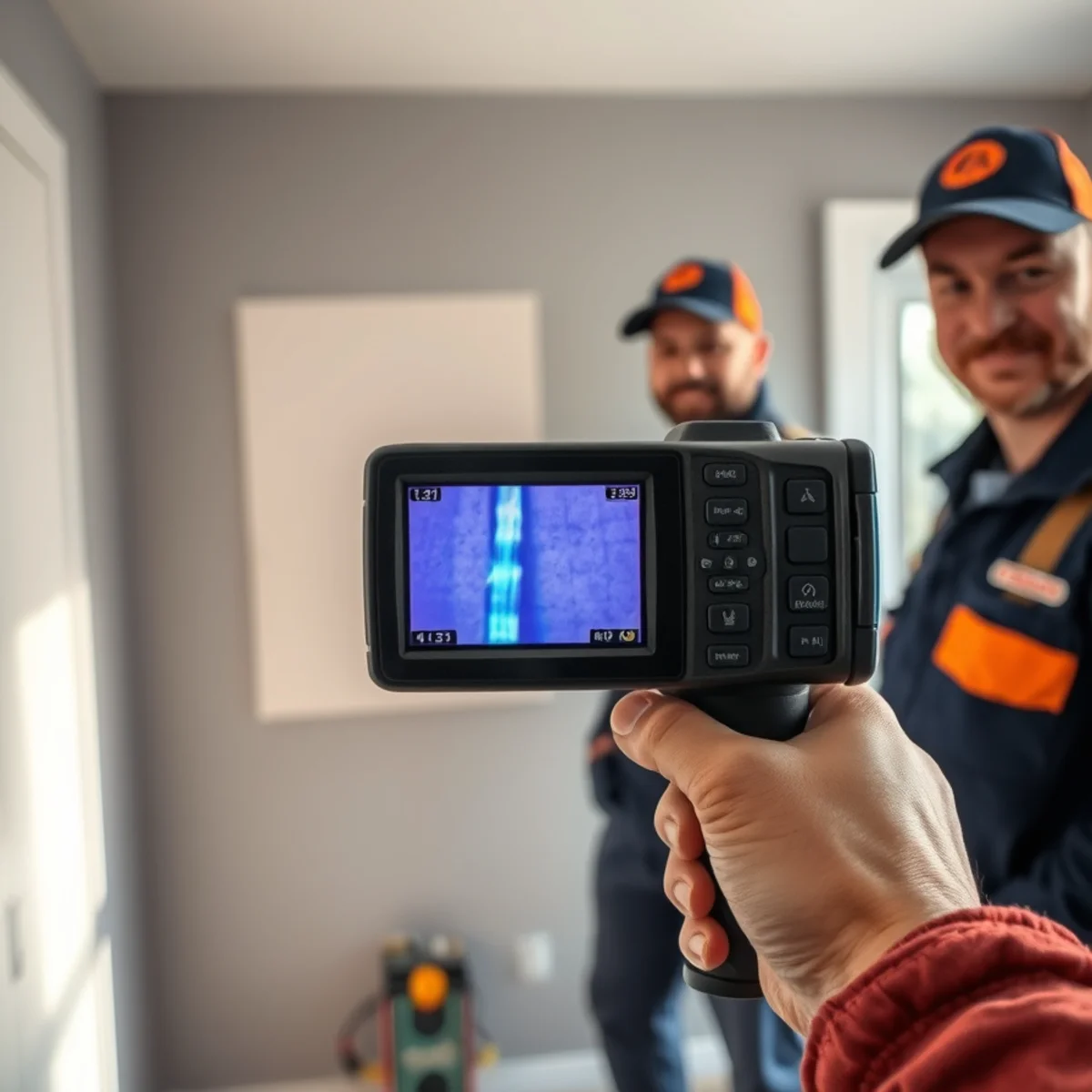
The old approach was to guess and start opening walls. We use acoustic listening equipment, which picks up the distinctive sound signature of pressurized water escaping through concrete, tile and drywall, and thermal imaging, which shows the temperature differential water movement creates behind a finished surface.
Combined with pressure isolation — shutting valves in sequence and watching the meter — that usually narrows a leak to a small area before anything is cut. The result is one deliberate opening in a location chosen for both access and easy patching, rather than four exploratory ones. Leak detection and repair is one of the places where the right equipment genuinely saves the homeowner money.
What it means for insurance
Most policies cover sudden and accidental water damage while excluding long-term seepage. That distinction is why acting on the early signs matters financially as well as structurally — a leak that has been running for a year is much harder to claim on than one caught in week two.
Photograph everything before repair, keep invoices, and call your carrier early. We can provide written findings for a claim. Homeowners across Catonsville and Woodlawn call us with exactly these symptoms every week, and catching it early is always the cheaper path.
Frequently asked questions
How much water can a small hidden leak waste?
A great deal, because it runs continuously. Even a slow drip adds up over months, and a pressurized pinhole inside a wall wastes far more than most people expect while causing structural damage the whole time.
Can you find a leak without breaking anything?
Finding it, usually yes — acoustic and thermal equipment locate leaks through finished surfaces. Repairing it eventually needs access, but the value of good detection is that the opening is one small deliberate cut rather than exploratory demolition.
Is a slab leak worth repairing, or should the line be re-routed?
It depends on the slab, the location and the condition of the rest of the system. Breaking the slab for a spot repair is sometimes right; abandoning the under-slab section and re-routing overhead is sometimes cheaper and far less disruptive. We price both and explain the trade-off.

Who wrote this
Collins & Sons LLC — Daniel Collins and family
We are a family plumbing business working out of 209 Westowne Rd in Catonsville, and we have been under Maryland houses for over 40 years — three generations of it. Most of what is on this page comes from doing the same jobs repeatedly on the same housing stock: pre-1950 homes off Frederick Road, galvanized supply, cast iron drainage, and water that runs 7–8.2 grains per gallon.
Licensed MHIC #117712 with the Maryland Home Improvement Commission and fully insured. We pull the Baltimore County permits on water heaters, sewer work and gas piping, and we meet the inspector ourselves.