
A sump pump is the cheapest insurance policy in your house and the one most likely to be quietly broken. It sits in a pit in the corner of the basement doing nothing for months, and the day it matters is the day a summer cell parks over Baltimore County and drops two inches in ninety minutes.
The good news is that almost every failure we get called to is preventable, and the check takes about twenty minutes. Do it in spring, before the season, rather than during a storm at ten at night.
The five-gallon test
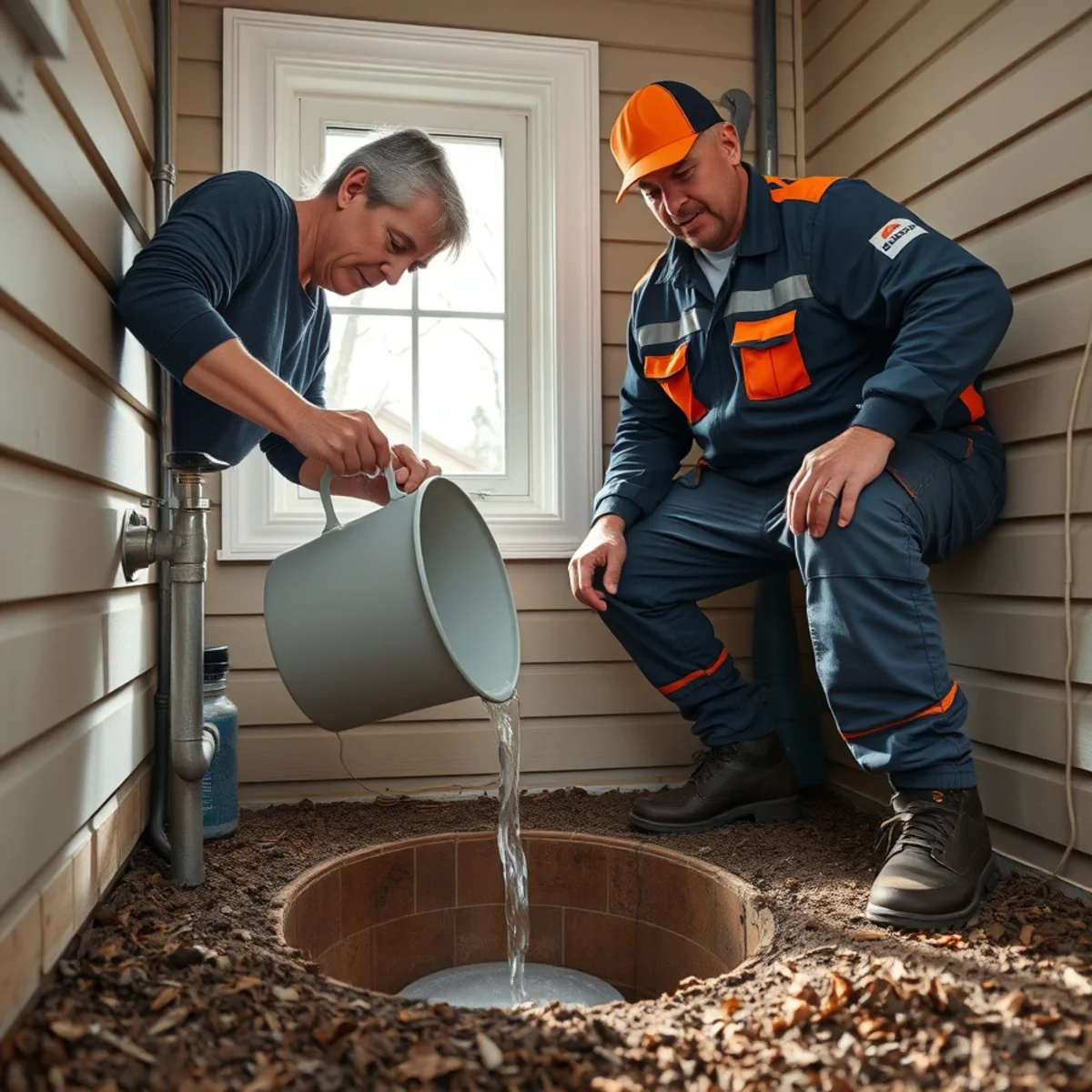
Everything starts here. Take a five-gallon bucket of water and pour it slowly into the pit. Watch what happens.
The float should rise, the pump should kick on, and the pit should clear promptly. Then the pump should shut off cleanly without short-cycling. If any part of that does not happen, you have found your problem in April instead of July.
- Pump does not start → float switch fouled or wedged, or the pump has failed.
- Pump hums but water level does not drop → jammed impeller or a blocked discharge line.
- Pump runs and then immediately restarts → almost always a failed check valve letting the discharge column fall back in.
- Pump runs on after the pit clears → float not dropping freely.
- Grinding or rattling → bearing or impeller damage. Plan a replacement.
Check the pit itself
Look inside. Gravel, silt, construction debris and rust flakes accumulate over the years and are the most common cause of a jammed impeller or a float that cannot move freely.
Clean it out. Also check that the float has clearance on all sides — a pump that has shifted in the pit so the float rests against the wall will never trigger, and it is a genuinely common finding.
Follow the discharge line outside
This is the part homeowners skip and it causes a surprising share of "the pump ran but the basement still flooded" calls.
Walk outside and find where the pipe lets out. It should discharge well away from the foundation — a discharge terminating four feet from the wall is simply recycling the same water back into the ground beside your basement. The outlet should be clear of leaves, mulch and soil, and the run should have proper pitch with no low spots that can hold water and freeze.
- Clear the outlet of debris and check it has not been buried by landscaping.
- Confirm the line discharges far enough from the foundation to actually leave.
- Check for crushed or kinked sections, especially where the line crosses a drive or path.
- In late autumn, confirm freeze protection — a frozen discharge turns the pump into a device that hums, overheats and burns out.
Test the check valve
The check valve sits on the discharge line just above the pump and stops water in the vertical column falling back into the pit when the pump shuts off. When it fails, every cycle sends the same water down twice, so the pump runs roughly double what it needs to.
The symptom is a distinct back-flow gurgle immediately after the pump stops, often followed by the pump restarting. It is an inexpensive part and replacing it is one of the highest-value small jobs in a wet basement.
The backup question
Here is the local reality that decides this. In Maryland the storm that fills your pit and the outage that kills your pump are the same weather system. It is not bad luck, it is cause and effect — heavy wind and rain bring down the lines.
If your basement is finished, if you keep anything down there you would be upset to lose, or if you have ever taken water, a battery backup is not an upsell. It is a second pump on a deep-cycle battery that takes over when power fails or when inflow exceeds what the primary can move.
Batteries need replacing every three to five years, and a backup system with a dead battery is decoration. Test it under load as part of this same spring check. Sump pump installation and battery backup systems are among the most common jobs we do in Elkridge and the lower-lying parts of Catonsville for exactly this reason.
How old is too old?
Seven to ten years is the usual range, but run time matters more than age. A pump in a dry basement can go fifteen years. A pump cycling every few minutes through a wet spring can be finished in four.
If yours is past seven and runs frequently, replacing it on your schedule costs the same as replacing it in an emergency and involves considerably less water on the floor. Cast iron pumps with mechanical float switches cost more than plastic units with tethered floats and last significantly longer in a pit that works hard — in a wet Maryland basement the better pump is the cheaper pump over ten years.
The twenty-minute checklist
- Pour five gallons into the pit and confirm the pump starts, clears the pit and shuts off cleanly.
- Clean silt, gravel and debris out of the pit.
- Confirm the float moves freely with clearance on all sides.
- Listen for back-flow gurgle after shutdown — that is the check valve.
- Walk the discharge line outside and confirm it is clear, pitched and terminating well away from the foundation.
- Test the backup system under load and check the battery date.
- Note the pump's age. Past seven years with heavy run time, start planning.
- Make sure the pump is on a working outlet and that the GFCI, if there is one, has not tripped.
Frequently asked questions
How often should I test my sump pump?
Twice a year at minimum — spring before storm season and autumn before the freeze. If your pump runs frequently, quarterly is better. The five-gallon test takes two minutes once you have done it once.
Should the pump be on a GFCI outlet?
Requirements vary by jurisdiction and installation date. The practical concern is that a nuisance GFCI trip disables the pump silently, so if yours is on one, include checking it in your routine. We will advise on what is required and appropriate for your specific setup.
My pump runs constantly. Is that normal?
It can be with a genuinely high water table, but check the simple causes first — a failed check valve or a pit that is too shallow both cause roughly double the necessary run time. Both are inexpensive to fix and both dramatically shorten pump life if ignored.

Who wrote this
Collins & Sons LLC — Daniel Collins and family
We are a family plumbing business working out of 209 Westowne Rd in Catonsville, and we have been under Maryland houses for over 40 years — three generations of it. Most of what is on this page comes from doing the same jobs repeatedly on the same housing stock: pre-1950 homes off Frederick Road, galvanized supply, cast iron drainage, and water that runs 7–8.2 grains per gallon.
Licensed MHIC #117712 with the Maryland Home Improvement Commission and fully insured. We pull the Baltimore County permits on water heaters, sewer work and gas piping, and we meet the inspector ourselves.