
A general home inspection is genuinely useful and it is not a plumbing inspection. The inspector will run the taps, check that fixtures drain, look for visible leaks and note the age of the water heater. That is a reasonable standard of care and it misses the four things most likely to hand you a five-figure bill in the first two years.
Here is what to check on a pre-1970 Maryland house, roughly in order of how expensive it is to get wrong.
1. The sewer lateral — the big one
The pipe running from the house, under the front yard, to the public main. In Baltimore County it becomes entirely your responsibility the moment you settle, and standard inspections do not include it.
On a pre-1970 Catonsville property it is very likely vitrified clay laid in short jointed sections, under a yard that has been growing an oak over it for seventy years. Roots find the joints. Piedmont clay soil settles the pipe into low spots. Neither is visible from the surface.
A camera scope costs a small fraction of any sewer repair and it is the best money in the whole inspection budget on an older house. You get footage, a written summary and — importantly — a negotiating position if it finds something.

2. What the supply piping is made of
Go to the basement and look at the pipe where the water service enters, and at the visible runs above.
Galvanized steel is dull grey threaded pipe with screwed fittings, and a magnet sticks to it. It corrodes from the inside, so the bore narrows invisibly for decades before anything leaks. If a house still has substantial galvanized, you are buying a whole-house repipe on an unknown timetable.
Copper is reddish-brown with soldered joints. Sound copper is good news. Copper installed between the 1960s and 1990s is in the age bracket where regional pinhole leaks appear, which is worth knowing rather than panicking about.
PEX is flexible plastic tubing, usually red, blue or white — modern and fine.
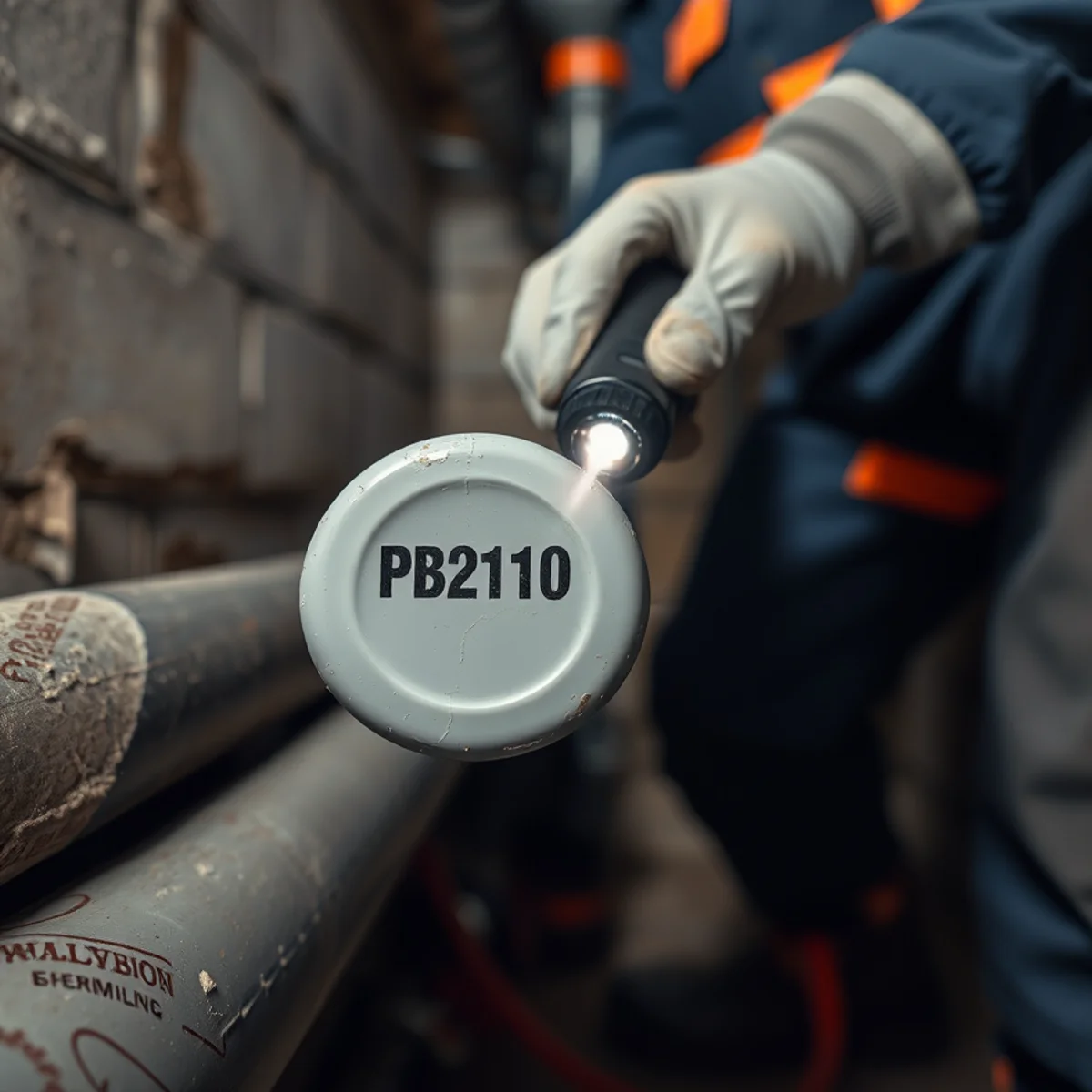
Grey flexible plastic stamped PB2110 is polybutylene, and that deserves its own conversation. See our guide to polybutylene for what it means.

The tell most buyers miss
Look for a house that has been *partially* repiped. A copper branch to a 1975 bathroom, a PEX run to a kitchen addition, and original galvanized everywhere else. That is extremely common in Catonsville and it means two things: there is still galvanized in the walls, and where the different metals meet without dielectric separation, corrosion is running fast at the junction.
3. Water heater age and permit status
The rating label carries a serial number that encodes the manufacture date. Anything over ten years is a replacement to budget for, and in this water anything over about seven has already had a hard life.
The less obvious check is whether it was permitted. Water heater replacement requires a permit in Baltimore County and every jurisdiction we work in. An un-permitted heater is a common finding and a common closing complication.
While you are there, look for a drain pan, an expansion tank, and whether the venting looks appropriate for the appliance. Missing expansion control is very common on older installations that became closed systems when a check valve went in at the meter.

4. Pre-1986 construction and lead solder
Lead solder was used to join copper pipe until it was banned for potable water in 1986. Any house plumbed or repiped before then may have lead-bearing joints, and Catonsville has a great deal of housing well older than that.
This is not a reason to walk away and it is a reason to know, particularly with young children. It is a laboratory water test at the tap, not a strip test, and the sample that matters is first-draw water that has been standing overnight. Our guide to local water quality covers what to do about it.

The half-hour walkthrough you can do yourself
- Run every fixture at once. Two showers and a tap. Pressure that collapses points at an undersized or corroded supply, a failed pressure reducing valve, or scaled piping.
- First-draw water in the morning. Brown or rusty means galvanized or a corroding water heater.
- Turn every shutoff valve under sinks and toilets. In hard water they calcify open and snap when forced. A house where none of them turn is a house needing a day of small work.
- Find and turn the main shutoff. If it will not move, add it to the list.
- Look at the ceiling below every bathroom for staining, and press the floor around each toilet for softness.
- Check the basement floor around the water heater and along the base of the walls for staining, efflorescence or a tide mark.
- Look for a sump pit. If there is one, there is a reason. Test it with a bucket of water.
- Check whether there is an exterior sewer cleanout. Many older Catonsville houses have none, which makes every future drain call more expensive.
What to do with what you find
Findings are leverage before settlement and expenses after it. That is the entire argument for doing this work during the inspection window rather than in month three of ownership.
Buyers commonly use a sewer scope result to request a repair before settlement, to negotiate a credit, or occasionally to walk away. Any of those beats absorbing the cost personally.
A pre-purchase camera inspection gets turned around quickly to fit a contract timeline, and we provide written findings you can put in front of an agent. Where the wider system needs assessing, a whole-house survey on an older property gives you a prioritised list rather than a scare.
And if you are already in
Most of the above still applies — it just becomes planning rather than negotiating. Knowing that your supply system has five years left rather than fifteen changes how you approach a kitchen remodel, and it is far better information to have before the tile goes on than after.
We do this work across Catonsville, Ellicott City and the older neighbourhoods throughout Baltimore and Howard County.
Frequently asked questions
Is a sewer scope worth it on every older house?
On anything built before roughly 1970, yes. It is the one system that is buried, expensive, entirely yours after settlement, and excluded from a standard inspection. On a newer house with PVC it is less critical.
The seller says the plumbing was updated. Should I still check?
Yes, and check what "updated" means. Partial repipes are extremely common and the phrase covers everything from a full replacement to a new bathroom branch. Look at the basement yourself — the pipe tells you the truth.
How much should I budget for plumbing on an older house?
It depends entirely on what the survey finds, which is the point of doing one. What we can say is that the expensive items — a full repipe, a sewer lateral replacement — are far more manageable when you know about them at offer stage than when they surprise you.
Who wrote this
Collins & Sons LLC — Daniel Collins and family
We are a family plumbing business working out of 209 Westowne Rd in Catonsville, and we have been under Maryland houses for over 40 years — three generations of it. Most of what is on this page comes from doing the same jobs repeatedly on the same housing stock: pre-1950 homes off Frederick Road, galvanized supply, cast iron drainage, and water that runs 7–8.2 grains per gallon.
Licensed MHIC #117712 with the Maryland Home Improvement Commission and fully insured. We pull the Baltimore County permits on water heaters, sewer work and gas piping, and we meet the inspector ourselves.