
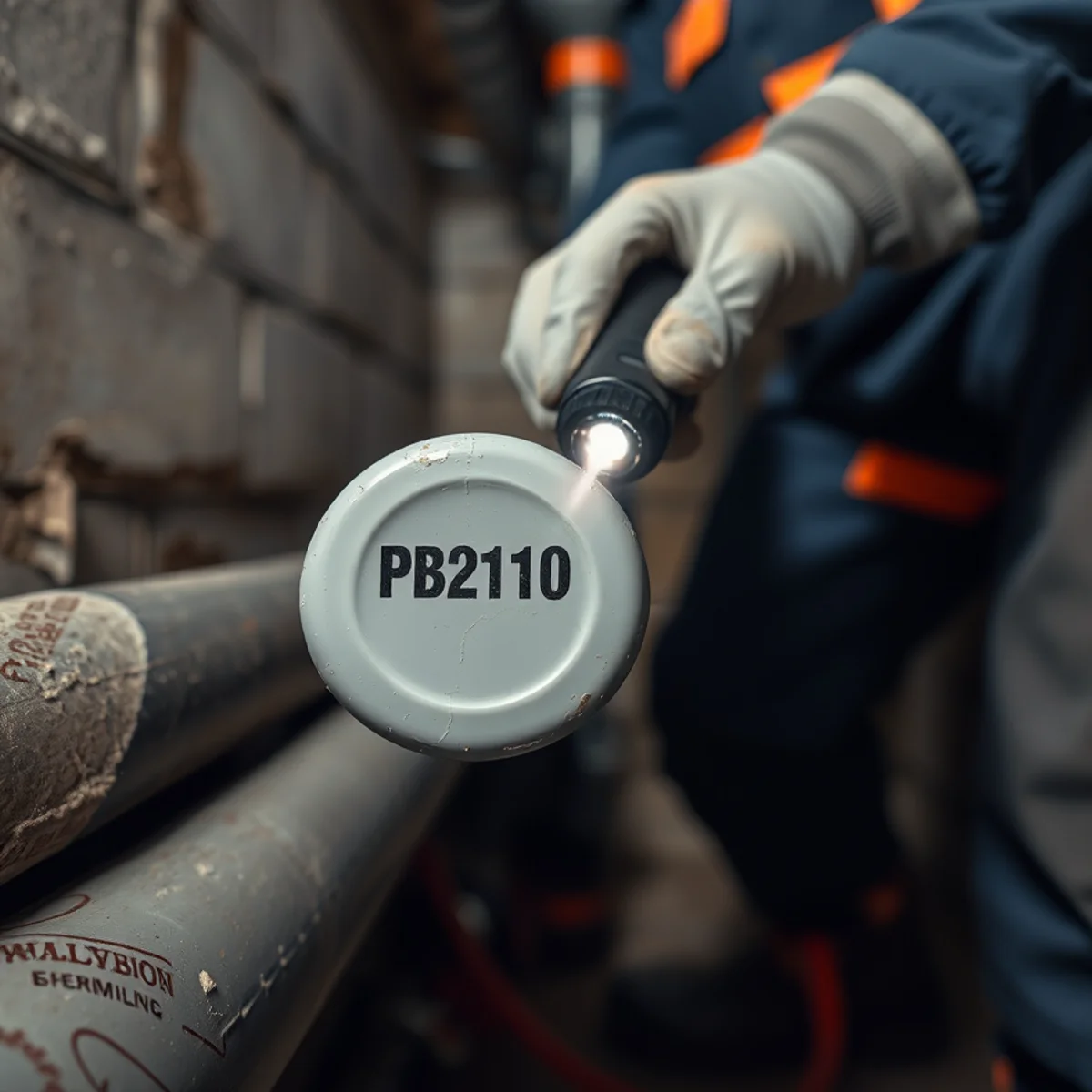
Polybutylene is grey flexible plastic pipe installed widely in American homes from the late 1970s through the mid 1990s. It was cheap, quick to install and widely adopted — and it developed a well-documented reputation for failure that led to one of the largest class action settlements in US construction history.
That settlement has long since closed. What remains is a lot of houses with polybutylene still in the walls, and a lot of owners who do not know it.
How to identify it in ten minutes
- Colour and feel. Grey is the most common for interior supply, though blue and black were also used, particularly for buried service lines. It is flexible plastic, not rigid.
- The stamp. Look for "PB2110" printed along the pipe. That is the definitive identifier.
- Where to look. Where the water service enters the basement, at the water heater connections, and at exposed runs near sinks and toilets. Also check behind the access panel to a tub or shower if there is one.
- The fittings. Original installations often used grey acetal plastic fittings with metal crimp rings. Copper crimp fittings were used later.
- The build year. Late 1970s through about 1995 is the window. In our service area that means a lot of the newer Columbia villages, the 1980s development in Owings Mills and White Marsh, and similar-era construction throughout the region.
Why it has the reputation it does
The failure mechanism was understood to involve oxidants in treated municipal water — chlorine principally — reacting with the material over time, causing it to become brittle and develop micro-fractures from the inside out.
The practical consequence is that failures were unpredictable and often occurred without warning at fittings or mid-run, sometimes in walls or ceilings. That unpredictability is what made it so damaging, because a pipe that fails gradually gives you a warning and one that fails suddenly gives you a flooded house.
It is worth being measured about this: a great deal of polybutylene has been in service for forty years without incident, and plenty of the original failures were attributed to the acetal fittings rather than the pipe itself. Nobody can tell you with confidence when a given installation will fail — which is precisely the problem.
The practical issues even where it has not failed
Insurance
Some carriers decline to write policies on homes with polybutylene supply, some charge more, and some ask about it explicitly. This varies by carrier and it changes. Worth checking with yours rather than assuming.
Home sale
It comes up. A buyer's inspector will identify it, and it becomes a negotiating item. Sellers who discover it during a transaction have far less room than sellers who knew and planned.
If you are thinking of selling in the next few years and you have polybutylene, knowing now is worth a great deal. Our guide to selling covers the wider list.
Repairs
Polybutylene is no longer manufactured for potable water in the US. Repairs are made by transitioning to modern material at the failure point, which means a house with polybutylene accumulates patches over time. Each repair is straightforward and none of them addresses the rest of the system.
What to do about it
The options are honest and there are only really two.
Monitor and repair as it fails. Viable if the system has been trouble-free, if you are not planning to sell soon, and if your insurer is comfortable. Reduce the risk by knowing where your main shutoff is and testing it, and by considering an automatic leak-detection shutoff — particularly if the property is ever empty for stretches.
Replace it. A whole-house repipe in PEX or copper removes the uncertainty permanently. It also resolves the insurance and resale questions in one move, and it is far cheaper done on your schedule than after a failure in a finished ceiling.
What replacement involves
Broadly the same as any repipe: mapping the existing runs, planning routes that minimise wall openings, installing new supply lines, pressure testing, inspection under permit, and patching back to a paint-ready surface.
The good news relative to a galvanized repipe is that houses of this era generally have drywall rather than plaster and lath, and frequently have more accessible chases. That makes the job less invasive and less expensive than the same work in a pre-war house.
It can also be staged. We commonly start with the trunk lines and risers and complete branch runs later, planned so nothing done first has to be undone. We do this work across Columbia, Owings Mills and the 1980s development throughout our service area.
Frequently asked questions
Is the class action settlement still open?
No. The main settlement programme closed in the early 2000s. Any replacement now is at the homeowner's cost, which is worth knowing before searching for a claim.
My polybutylene has never leaked. Do I have to replace it?
There is no requirement. The considerations are the unpredictability of failure, what your insurer says, and what happens at sale. Plenty of owners monitor and repair; plenty decide the uncertainty is not worth carrying. Both are defensible.
Can polybutylene be used for the buried service line too?
Yes, blue polybutylene was widely used for buried service lines. If you have grey PB inside, it is worth checking what runs from the meter as well — that section is the property owner's responsibility and a failure there is a yard excavation.

Who wrote this
Collins & Sons LLC — Daniel Collins and family
We are a family plumbing business working out of 209 Westowne Rd in Catonsville, and we have been under Maryland houses for over 40 years — three generations of it. Most of what is on this page comes from doing the same jobs repeatedly on the same housing stock: pre-1950 homes off Frederick Road, galvanized supply, cast iron drainage, and water that runs 7–8.2 grains per gallon.
Licensed MHIC #117712 with the Maryland Home Improvement Commission and fully insured. We pull the Baltimore County permits on water heaters, sewer work and gas piping, and we meet the inspector ourselves.