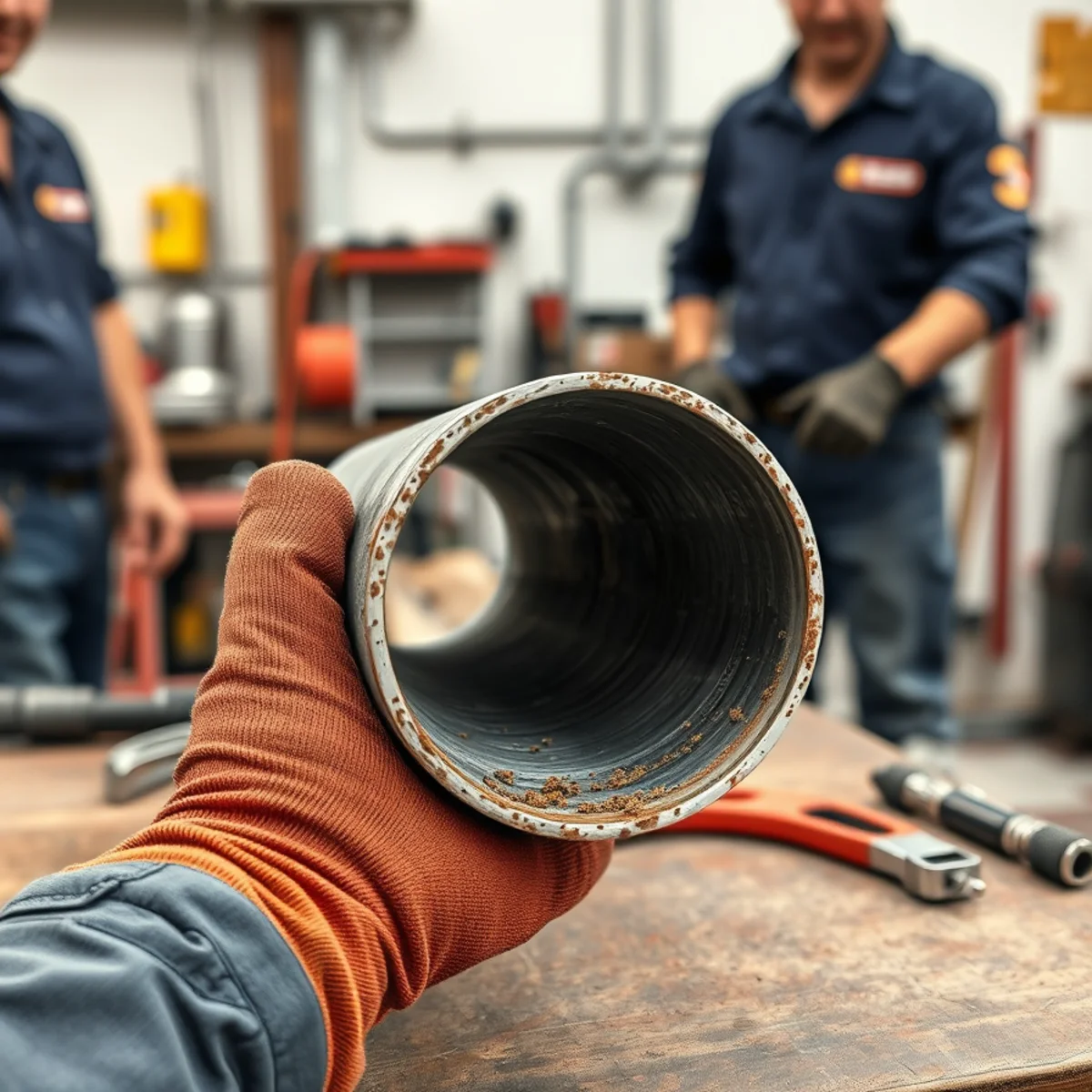

When a repipe becomes the sensible option, this is the first question homeowners ask, and there is a great deal of confident nonsense written about it in both directions.
Both materials are code-approved. Both will comfortably outlive the galvanized steel they are replacing. Here is what actually decides between them in a Maryland house.
The case for PEX
- It routes through existing cavities. This is the big one in an older house. PEX is flexible, so it can be fished through wall bays, chases and joist runs the way electrical cable can. Copper needs a straight, accessible path and rigid fittings at every direction change.
- Fewer wall openings. Directly downstream of the point above. On a plaster-and-lath house — which is most of pre-war Catonsville — every opening avoided is a plaster repair you do not pay for, and plaster does not patch like drywall.
- Fewer joints. A home-run or manifold layout can serve a fixture with a single continuous length. Joints are where systems fail; fewer joints is fewer failure points, and most of them are accessible at the manifold rather than buried.
- Freeze tolerance. PEX expands considerably before it splits. It is not freeze-proof and it is far more forgiving than rigid copper, which matters in Maryland crawl spaces and garage-wall runs.
- Quieter. No water hammer transmitted through rigid pipe, no expansion ticking.
- Cheaper installed. Material costs less and labour is lower because the installation is faster and involves less demolition.
The case for copper
- A century of proven service. We know exactly how copper behaves over sixty years because we work on sixty-year-old copper every week.
- Better for exposed runs. In a basement or utility room where the pipe is visible, copper simply looks like proper plumbing and takes knocks better.
- Higher temperature and UV tolerance. PEX must not be exposed to sunlight and has temperature limits. Neither matters in most residential interiors, and both matter in specific situations.
- No question about long-term chemistry. PEX is well tested and widely approved, and copper has simply been doing it longer. For some homeowners that certainty is worth the difference.
- Preferred in some historic renovations, where visible mechanical work is expected to look period-appropriate.
The honest objections to each
Against PEX
It is not appropriate for exposed exterior runs or anywhere it sees sunlight. Rodents can damage it, which is worth considering in a crawl space with a known problem. And the fittings matter — a properly made expansion or crimp connection is reliable, and a badly made one is a leak. That is an installer question rather than a material question.
Against copper
Pinhole leaks are a documented regional issue around Baltimore. Copper installed between the 1960s and 1990s pits and perforates, and the failures cluster — the water heater outlet run and the long horizontal basement runs go first.
Nobody can tell you with certainty that copper installed today will behave the same way as copper installed in 1965, because the water chemistry, the pipe manufacturing and the installation practices have all changed. But it is a fair question to ask, and anyone who dismisses it out of hand is not being straight with you.
What actually decides it in a Catonsville house
Nine times out of ten, the walls.
Much of the older housing stock here is plaster and lath. It does not cut cleanly, it does not patch like drywall, and restoring it properly is specialist work that costs more than the plumbing behind it.
A copper repipe in a plaster house needs a straight accessible route to every fixture, and where that route does not exist, it needs an opening. A PEX repipe can frequently be fished through existing cavities from the basement and the attic with a fraction of the openings.
That is why we recommend PEX for most older homes here, and it is a practical recommendation rather than an ideological one. On a house with a full unfinished basement, an accessible attic, and drywall throughout, the calculation is much closer.
What we do in practice
Frequently both. PEX for the branch runs fished through walls and ceilings; copper for the exposed basement trunk lines and manifold area where it will be seen and where it takes knocks.
That combination gets the routing advantage where it matters and the durability and appearance where that matters. It is a perfectly normal way to do a whole-house repipe and nobody should tell you it has to be one or the other throughout.
The questions to ask any contractor
- Which material, and specifically why for my house?
- How many wall openings, and where? Ask for them to be marked before work starts.
- What is the fitting system — expansion, crimp, or push-fit? Push-fit connectors are excellent for repairs and are not what a whole-house repipe should rely on inside walls.
- Is the work permitted and inspected before anything is closed up?
- Am I getting photographs of the rough-in before it is covered?
- What is included in making good — paint-ready patching, or nothing?
- Can this be staged, and if so what is the phase order?
One thing that matters more than the material
Whichever you choose, the pipe is only as good as the water going through it. Catonsville water runs about 7 to 8.2 grains per gallon, and scale accumulates inside any material.
If you are already spending on a repipe, it is worth pricing treatment at the same time. It is the cheapest it will ever be to add, and it protects the investment you are about to make. We do this work throughout Catonsville and the older neighbourhoods of Hyattsville and across the region.
Frequently asked questions
How long does PEX last?
Manufacturers typically warrant it for 25 years and expected service life estimates run considerably longer. It has been in widespread use in Europe since the 1970s and in the US since the 1980s, so the long-run data is genuinely reassuring.
Does PEX affect water taste?
Some homeowners report a faint plastic taste in the first weeks after installation, which dissipates. Flushing the system thoroughly on commissioning largely resolves it. It is worth knowing about rather than being surprised by.
Can I mix PEX and copper?
Yes, and we frequently do — PEX for fished branch runs, copper for exposed trunk lines. The transitions need proper fittings, and where copper meets galvanized anywhere in a system, dielectric separation matters to prevent accelerated corrosion at the junction.

Who wrote this
Collins & Sons LLC — Daniel Collins and family
We are a family plumbing business working out of 209 Westowne Rd in Catonsville, and we have been under Maryland houses for over 40 years — three generations of it. Most of what is on this page comes from doing the same jobs repeatedly on the same housing stock: pre-1950 homes off Frederick Road, galvanized supply, cast iron drainage, and water that runs 7–8.2 grains per gallon.
Licensed MHIC #117712 with the Maryland Home Improvement Commission and fully insured. We pull the Baltimore County permits on water heaters, sewer work and gas piping, and we meet the inspector ourselves.